
Palmetto General Hospital Stroke Patient Outcomes
Comprehensive Stroke Care, Around the Clock
When a stroke strikes, every minute matters. Palmetto General Hospital’s Comprehensive Stroke Program provides 24-hour access to specialized teams, access to advanced diagnostic imaging, emergency neurointerventional procedures, neurosurgical care, and dedicated neurological intensive care. Palmetto’s approach brings together timely treatment, compassionate support, rehabilitation planning, and ongoing education for patients & families.
A Comprehensive Approach to Stroke
Our multidisciplinary team coordinates care from emergency medical services and rapid hospital evaluation throughout treatment, recovery, and follow up. Palmetto offers specialized resources like advanced neuroimaging, a biplane neurointerventional suite, hybrid procedure rooms, neurosurgical consultation & intervention, a dedicated neuro-ICU, neurological telemetry, and rehabilitation services.
Advanced Treatment Options
Ischemic Stroke
Rapid assessment for appropriate intravenous thrombolytic therapy and endovascular thrombectomy to restore blood flow when clinically indicated.
Hemorrhagic Stroke & Aneurysms
Specialized evaluation and treatment that may include aneurysm coiling, flow-diversion devices, surgical clipping, and other neurosurgical procedures.
Complex Neurovascular Conditions
Diagnostic cerebral angiography, carotid artery stenting, embolization procedures, and management of cerebral vasospasm for selected patients.
Experience & Timely Care
Palmetto General Hospital’s program tracks treatment timelines and procedural volumes as part of its commitment to quality. The figures below are program-reported results; 2026 figures cover January through September and are not directly comparable with a complete calendar year.
Our Mission & Vision
Our mission is to provide timely, compassionate, evidence-based, and patient-centered stroke care through multidisciplinary collaboration, education, and continuous performance improvement.
Our vision is a sustainable, community-centered stroke program that advances stroke prevention, acute care, recovery, and the long-term well-being of patients and families.
LEARN MORE
To learn more about our comprehensive Stroke program, please review our quality data and outcomes, Florida Stroke Registry Data to see how Palmetto General Hospital compares to other hospitals in the region and state, and our community engagement and education program.
2025 Florida Stroke Registry Outcomes
FLORIDA STROKE REGISTRY DATA – HOW OUR HOSPITAL’S PERFORMANCE COMPARES TO OTHER REGIONAL AND STATE FACILITIES/STROKE CENTERS
Quality, Safety, and Continuous Improvement
Palmetto General Hospital reports Comprehensive Stroke Center certification through The Joint
Commission. Our team monitors evidence-based stroke care measures, treatment times, postprocedure care, rehabilitation assessments, and patient education. Participation in the Florida Stroke Registry supports ongoing review of care processes and opportunities to improve outcomes.
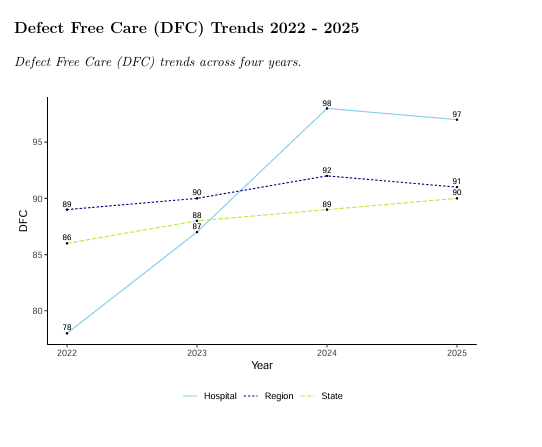
Our 2025 Florida Stroke Registry dashboard shows 97% defect-free care, reflecting the proportion of eligible interventions delivered to patients with acute ischemic stroke.
Defect Free Care (DFC) Trends 2022-2025
Defect Free Care (DFC) trends across four years.
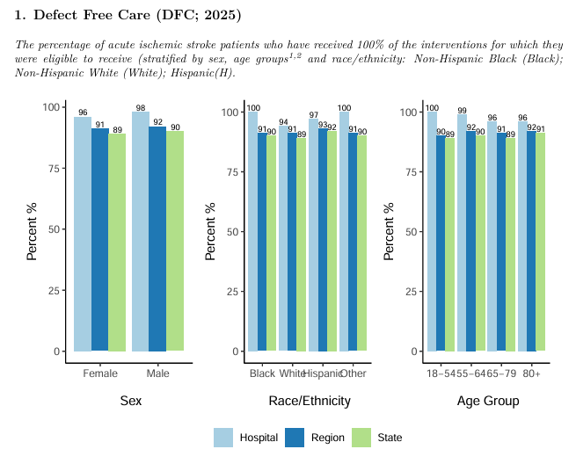
1. Defect Free Care (DFC; 2025)
The percentage of acute ischemic stroke patients who have received 100% of the interventions for which they were eligible to receive (stratified by sex, age groups and race/ethnicity: Non-Hispanic Black (Black); Non-Hispanic White (White); Hispanic (H)).
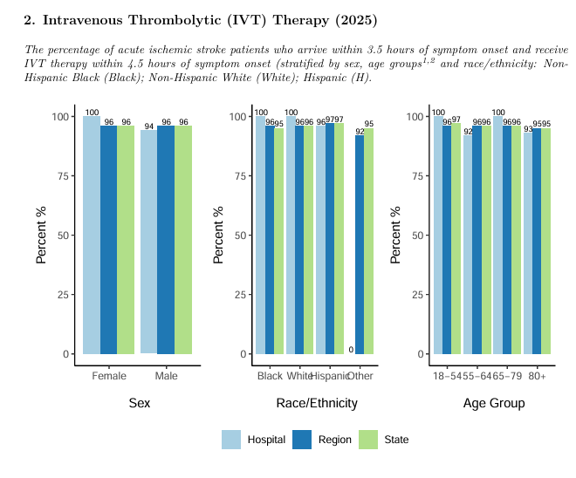
2. Intravenous Thrombolytic (IVT) Therapy (2025)
The percentage of acute ischemic stroke patients who arrive within 3.5 hours of symptom onset and receive IVT therapy within 4.5 hours of symptom onset (stratified by sex, age groups and race/ethnicity: Non-Hispanic Black (Black); Non-Hispanic White (White); Hispanic (H)).
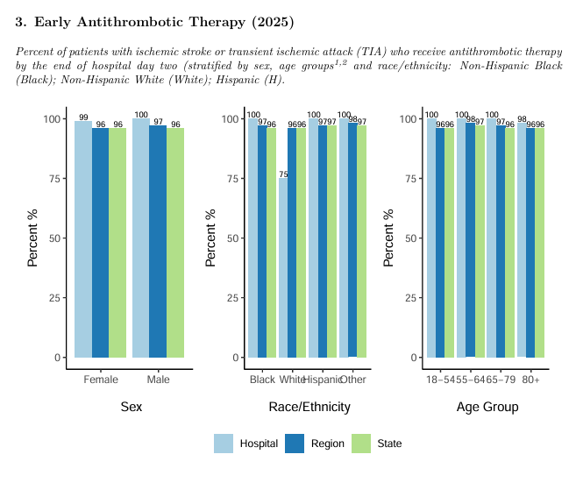
3. Early Antithrombotic Therapy (2025)
Percent of patients with ischemic stroke or transient ischemic attach (TIA) who receive antithrombotic therapy by the end of hospital day two (stratified by sex, age groups and race/ethnicity: Non-Hispanic Black (Black); Non-Hispanic White (White); Hispanic (H)).
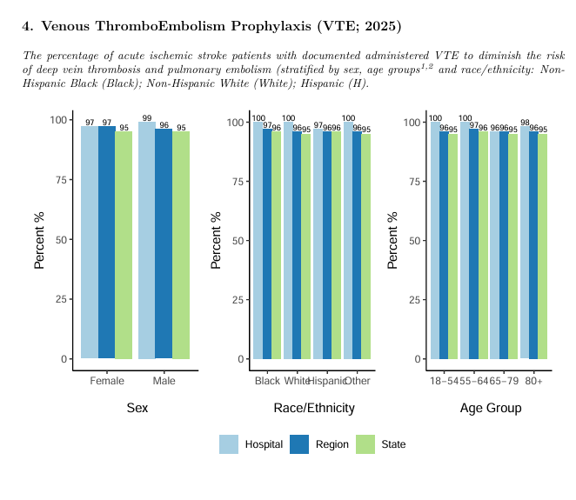
4. Venus ThromboEmbolism Prophylaxis (VTE; 2025)
The percentage of acute ischemic stroke patients with documented administered VTE to diminish the risk of deep vein thrombosis and pulmonary embolism (stratified by sex, age groups and race/ethnicity: Non-Hispanic Black (Black); Non-Hispanic White (White); Hispanic (H)).
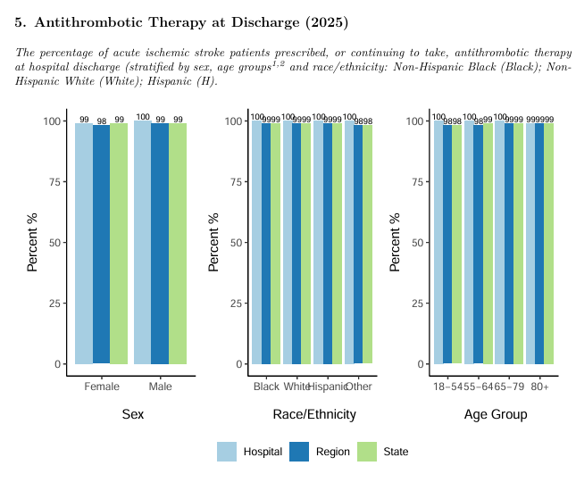
5. Antithrombotic Therapy at Discharge (2025)
The percentage of acute ischemic stroke patients prescribed, or continuing to take, antithrombotic therapy at hospital discharge (stratified by sex, age groups and race/ethnicity: Non-Hispanic Black (Black); Non-Hispanic White (White); Hispanic (H)).
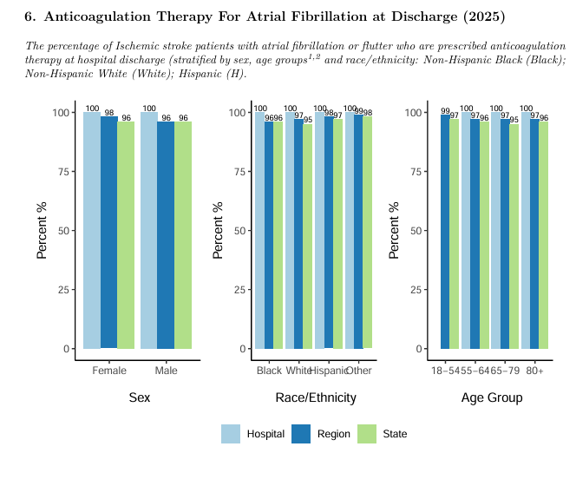
6. Anticoagulation Therapy for Atrial Fibrillation at Discharge (2025)
The percentage of Ischemic stroke patients with atrial fibrillation or flutter who are prescribed anticoagulation therapy at hospital discharge (stratified by sex, age groups and race/ethnicity: Non-Hispanic Black (Black); Non-Hispanic White (White); Hispanic (H)).
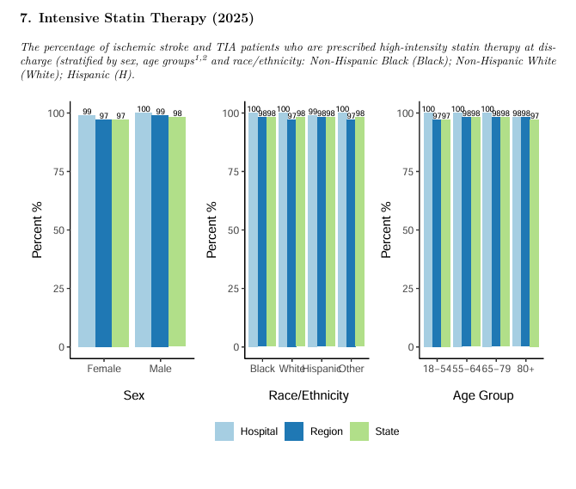
7. Intensive Statin Therapy (2025)
The percentage of ischemic stroke and TIA patients who are prescribed high-intensity statin therapy at discharge (stratified by sex, age groups and race/ethnicity: Non-Hispanic Black (Black); Non-Hispanic White (White); Hispanic (H)).
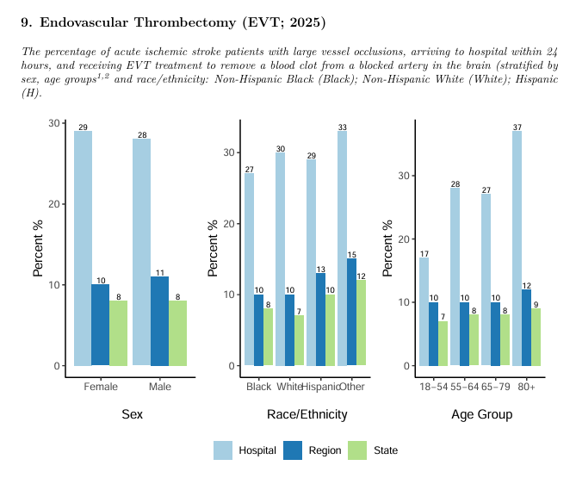
9. Endovascular Thrombectomy (EVT; 2025)
The percentage of acute ischemic stroke patients with large vessel occlusions, arriving to hospital within 24 hours, and receiving EVT treatment to remove a blood clot from a blocked artery in the brain (stratified by sex, age groups and race/ethnicity: Non-Hispanic Black (Black); Non-Hispanic White (White); Hispanic (H)).
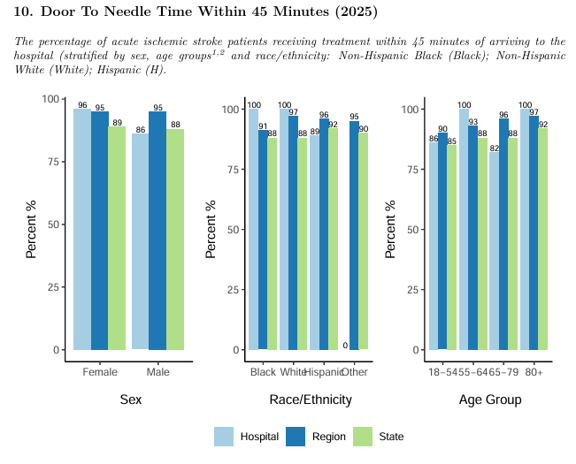
10. Door To Needle Time Within 45 Minutes
The percentage of acute ischemic stroke patients receiving treatment within 45 minutes of arriving to the hospital (stratified by sex, age groups and race/ethnicity: Non-Hispanic Black (Black); Non-Hispanic White (White); Hispanic (H)).
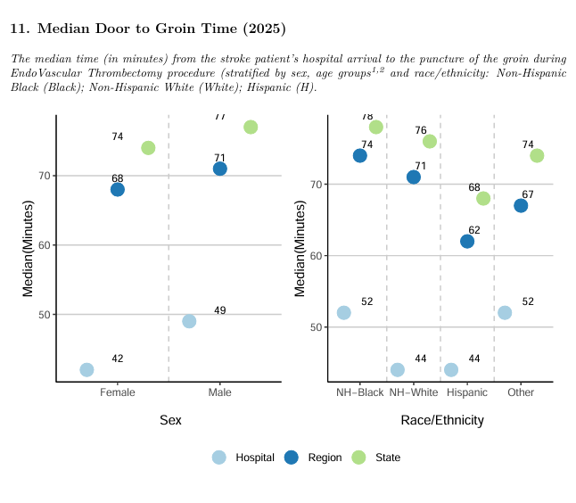
11. Median Door to Groin Time (2025)
The median time (in minutes) from the stroke patient’s hospital arrival to the punciton of the groin during EndoVascular Thrombectomy procedure (stratified by sex, age groups and race/ethnicity: Non-Hispanic Black (Black); Non-Hispanic White (White); Hispanic (H)).
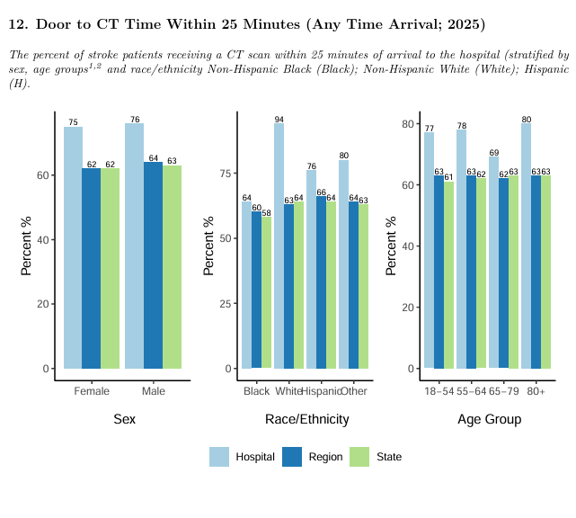
12. Door to CT Time Within 25 Minutes (Any Time Arrival; 2025)
The percent of stroke patients receiving a CT scan within 25 minutes of arrival to the hospital (stratified by sex, age groups and race/ethnicity: Non-Hispanic Black (Black); Non-Hispanic White (White); Hispanic (H)).
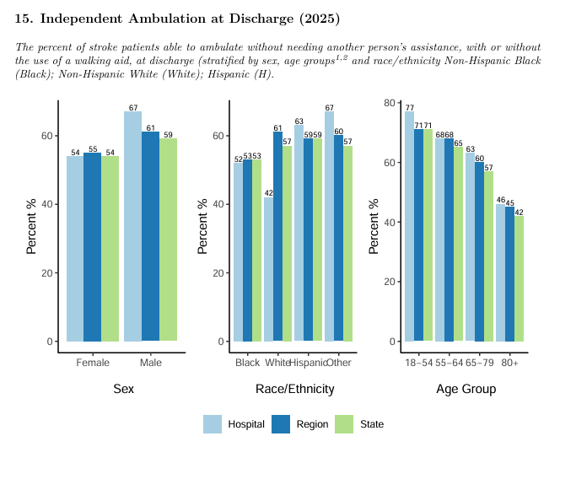
15. Independent Ambulation at Discharge (2025)
The percent of stroke patients able to ambulate without needing another person’s assistance, with or without the use of a walking aid, at discharge (stratified by sex, age groups and race/ethnicity: Non-Hispanic Black (Black); Non-Hispanic White (White); Hispanic (H)).
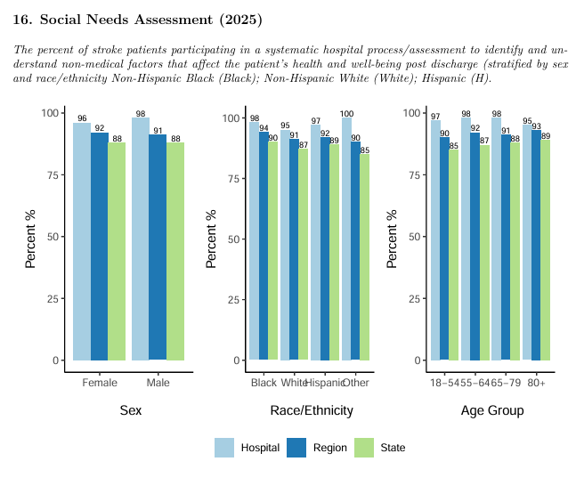
16. Social Needs Assessment (2025)
The percentage of stroke patients participating in a systematic hospital process/assessment to identify and understand non-medical factors that affect the patient’s health and well-being post discharge (stratified by sex, age groups and race/ethnicity: Non-Hispanic Black (Black); Non-Hispanic White (White); Hispanic (H)).
2024 Data Palmetto Stroke Stats
Door to IV Thrombolytic Therapy: (From patient arrival to administration time of an IV clot buster during an acute ischemic stroke that presents within 4.5 hours of symptom onset or last known well.)
(American Heart Association recommends 60 minutes from patient arrival time.)
- Door to IV Thrombolytic Therapy for 2024: 25-minute median treatment time
- Door to IV Thrombolytic Therapy for 2024: 32-minute mean treatment time
Door to Groin: (From patient arrival to femoral access/stick time to begin mechanical thrombectomy (removal of clot) during an acute ischemic stroke.)
(American Heart Association recommends 75 minutes door-to-groin access time for mechanical thrombectomies.)
- Door to Groin (Endovascular Treatment Time for Mechanical Thrombectomy): 46-minute median time
- Door to Groin (Endovascular Treatment Time for Mechanical Thrombectomy): 52-minute mean time
Door to Reperfusion: (From patient arrival to reperfusion time after clot is removed from the ischemic/target vessel during a stroke.)
(American Heart Association recommends 120 minutes door-to-reperfusion time for mechanical thrombectomies.)
- Door to Reperfusion (Endovascular Treatment Time for Mechanical Thrombectomy Post Recanalization of Target Ischemic Vessel): 79-minute median time
- Door to Reperfusion (Endovascular Treatment Time for Mechanical Thrombectomy Post Recanalization of Target Ischemic Vessel): 85-minute mean time
2023 Data Palmetto Stroke Stats
Door to IV Thrombolytic Therapy: (From patient arrival to administration time of an IV clot buster during an acute ischemic stroke that presents within 4.5 hours of symptom onset or last known well.)
(American Heart Association recommends 60 minutes from patient arrival time.)
- Door to IV Thrombolytic Therapy for 2023: 46-minute median treatment time
- Door to IV Thrombolytic Therapy for 2023: 38-minute mean treatment time
Door to Groin: (From patient arrival to femoral access/stick time to begin mechanical thrombectomy (removal of clot) during an acute ischemic stroke.)
(American Heart Association recommends 75 minutes door-to-groin access time for mechanical thrombectomies.)
- Door to Groin (Endovascular Treatment Time for Mechanical Thrombectomy): 54-minute median time
- Door to Groin (Endovascular Treatment Time for Mechanical Thrombectomy): 58-minute mean time
Door to Reperfusion: (From patient arrival to reperfusion time after clot is removed from the ischemic/target vessel during a stroke.)
(American Heart Association recommends 120 minutes door-to-reperfusion time for mechanical thrombectomies.)
- Door to Reperfusion (Endovascular Treatment Time for Mechanical Thrombectomy Post Recanalization of Target Ischemic Vessel): 92-minute median time
- Door to Reperfusion (Endovascular Treatment Time for Mechanical Thrombectomy Post Recanalization of Target Ischemic Vessel): 100-minute mean time